
Industrial lighting fixtures get specified by wattage and price more often than by environment, and that is the root of most premature failures. 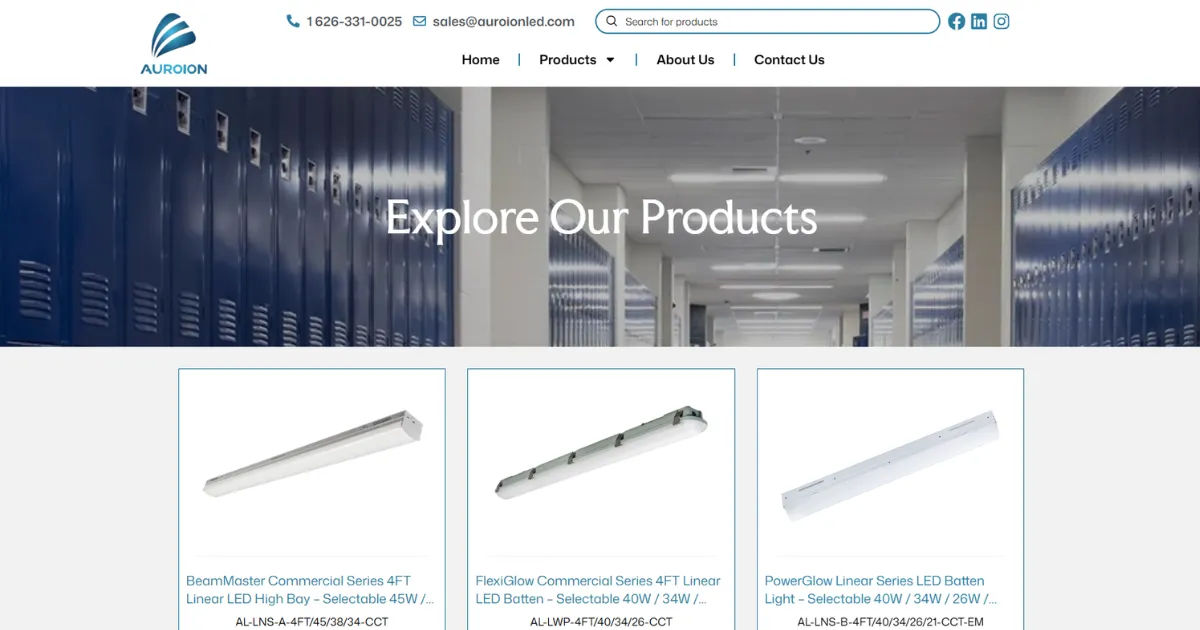 A fixture that performs perfectly in a dry, climate-controlled assembly area will fail inside two years in a wash-down bay 40 feet away. Same building. Same budget line. Completely different requirement.
The way to avoid that is to spec by environment first and photometrics second.
Map the Building by Environment, Not by Room
Walk the facility and sort every area into one of four buckets:
Dry and clean. Offices, dry storage, assembly with no airborne contaminant. Standard commercial fixtures are fine. Don’t overspend here.
Dusty. Woodworking, grain handling, cement, dry powder processing. Dust ingress coats optics and reduces output, and in some materials it is a combustion risk. IP65 minimum, and check whether the dust is classified.
Wet or wash-down. Food processing, commercial kitchens, car washes, bottling, cold storage. Direct water contact, pressure washing, condensation cycles. This is vapour tight territory, IP65 or IP66.
Chemically aggressive. Wastewater treatment, plating, chemical storage, agricultural buildings with high ammonia. Corrosion attacks housings and hardware. You want polycarbonate bodies, stainless fasteners, and gaskets rated for the specific exposure.
Most facilities have at least three of these. Buying one fixture for all of them is how budgets get spent twice.
The Ratings That Predict Failure
IP rating. First digit is solids, second is liquids. IP65 means dust-tight and protected against water jets. IP66 handles powerful jets, which is what pressure-washing means in practice. Below IP65, don’t bother in an industrial setting.
IK rating. Impact resistance, and widely ignored. IK08 withstands a 5-joule impact — roughly a 1.7kg mass dropped from 300mm. In a warehouse aisle where a forklift mast can clip a fixture, IK08 is a minimum and IK10 is better.
Ambient temperature rating. Look for the Ta figure on the datasheet. Many industrial lighting fixtures are rated Ta 40°C, which sounds generous until you measure the air near a ceiling in an uncooled facility in July. Ta 50°C or 55°C products exist for a reason. Cold storage needs the opposite check — a driver rated to -20°C or lower, since some won’t start reliably below freezing.
NSF listing. Non-negotiable in food processing and commercial kitchens. If it isn’t listed, the auditor will find it.
Mounting Height Decides the Fixture Family
Under 15 feet, linear vapour tight fixtures and strip fixtures work well and give even coverage across aisles.
Between 15 and 25 feet, you’re into high bay territory. Linear high bays suit racked aisles; round UFO high bays suit open floor.
Above 25 feet, beam angle becomes the dominant variable. Narrow optics of 60° or less get light to the floor without washing the rack faces.
Serviceability Is a Spec, Not an Afterthought
Ask three questions of any industrial fixture before ordering:
Can the driver be replaced without removing the fixture from the ceiling? On sealed units the answer is no, which turns a $40 part into a full replacement.
Are the mounting accessories included or extra? Surface, pendant, chain and cable mounts are frequently sold separately, and discovering that on delivery day costs you a crew.
Is the product line likely to exist in five years? Buying a discontinued private-label fixture means every future failure is a full replacement rather than a spare from the shelf.
Auroion LED, based in Pomona, California, supplies industrial lighting fixtures for wet and dusty environments alongside LED high bay lights for warehouse ceilings, so a mixed-environment facility can be specced from one source without compromising on any single area.
Frequently Asked Questions
What IP rating do industrial lighting fixtures need?
IP65 is the practical minimum for any dusty or damp industrial area, covering dust-tight sealing and protection from water jets. Move to IP66 where pressure washing occurs, and check the gasket material where chemicals or steam are present.
How do I know if my facility needs vapour tight fixtures?
If the area is washed down, sees condensation, handles food, or runs high humidity, you need vapour tight. A quick test: if maintenance ever points a hose at anything in that space, standard fixtures will fail there.
What’s the difference between industrial and commercial lighting fixtures?
Industrial fixture lighting is built for ingress protection, impact resistance and higher ambient temperatures, usually with sealed housings and heavier gauge materials. Commercial fixtures prioritise appearance, glare control and cost in climate-controlled interior spaces.
How long should industrial LED fixtures last?
Expect L70 at 50,000-100,000 hours for the LEDs, which is 12-25 years at typical industrial run hours. The driver is the shorter-lived component, so specify fixtures with field-replaceable drivers to avoid replacing whole units.